
Quickstart
Solve Problems Fast
Work is not perfect — hiding problems is the real failure
Daily work is full of problems. Some are small, some are critical. Some are obvious, others remain hidden for weeks. Some are named, many are not.
This is normal. There is no system, process, or tool that removes problems from real work.
What destroys organizations is not having problems — it is not seeing them early, not naming them clearly, and not solving them fast. KanBo is built for this reality.
KanBo shows the truth — even when it is uncomfortable
KanBo does not help create a “nice picture” of work. It does not support polishing reality for management. It does not hide delays behind status descriptions, dashboards, or presentations.
KanBo is a single source of truth. If work is stuck, it is visible. If responsibility is unclear, it is visible. If progress is slower than expected, it is visible. There is no place to hide problems — and that is exactly the point.
KanBo shows the truth — even when it is uncomfortable
Because KanBo reflects real execution, problems surface automatically:
- cards remain In Progress longer than expected,
- dependencies block further work,
- required documents or decisions are missing,
- work moves forward without clarity,
- outcomes are delayed or unfinished.
Nothing needs to be reported. Nothing needs to be escalated artificially. The system shows what is happening — as it happens.
Practical problem-solving in KanBo
Even the best workflows encounter issues. KanBo does not try to eliminate them — it provides clear mechanisms to detect and resolve them early, directly where work happens.
| Problem observed | Recommended action in KanBo |
| Work cannot move forward | Add a card blocker and document the reason directly on the card |
| No clear ownership | Assign or change the responsible person |
| Conflicting deadlines | Review dependencies and timelines using Gantt Chart view |
| Work taking longer than expected | Analyze progress using Time Chart or Forecast Chart |
| Wrong person assigned | Change the responsible person to reflect real responsibility |
| Missing or forgotten work | Create a new card or mirror card an existing Card into the Space |
| Dependency blocking progress | Add previous, next or linked card relation |
| Missing context or decision | Add a note, document, or comment directly to the card |
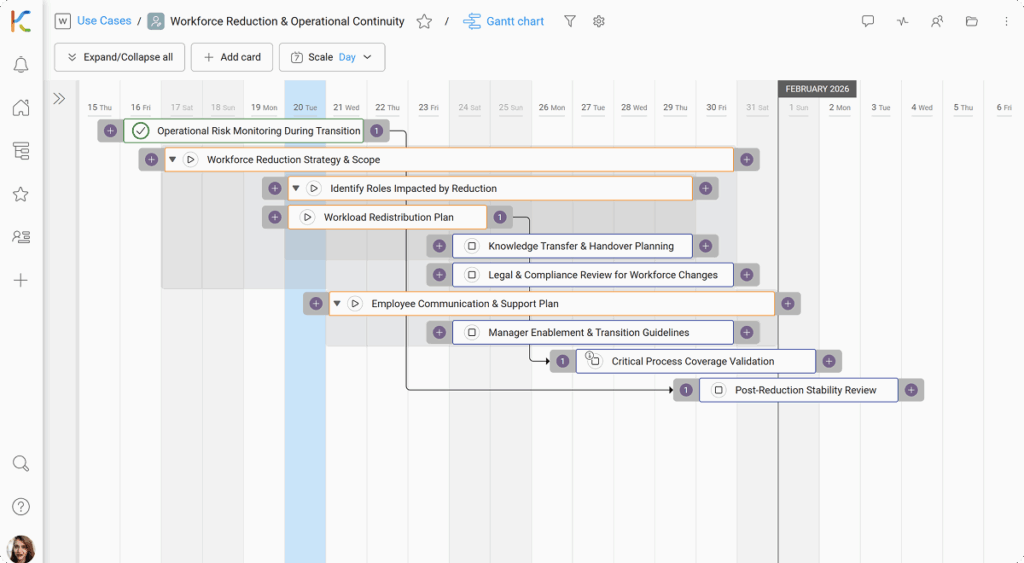
Gannt Chart view
A Gantt Chart view is a space view in the form of a bar chart that shows you a project schedule in a highly visual manner. The cards will be seen in a timeframe view and it’s easy to see their conditions in the present day.
Learn more about Gannt Chart view9
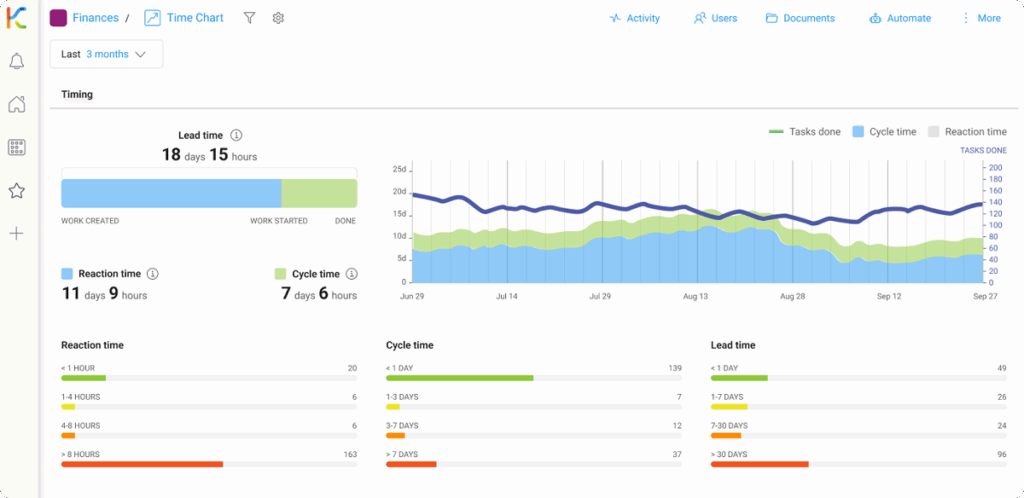
Time Chart
Time Chart is a space view that allows you to gain insights into the time it takes to complete tasks in your workflow. It provides you with valuable information about lead time, reaction time, and cycle time, which are essential metrics for measuring the efficiency of your processes.
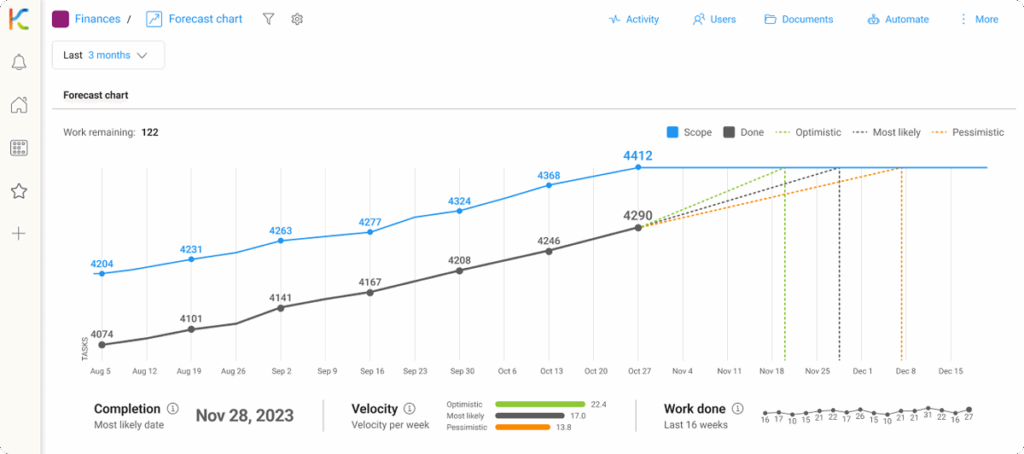
Forecast Chart
Forecast Chart in KanBo allows you to track the progress of your work and make data-driven forecasts. This chart provides valuable insights into the completion of your project, helping you understand how much work has been done and how much is left.
Why this matters
Problems do not require new tools or escalation paths. They require clarity, ownership, and immediate action.
KanBo ensures that:
- every problem has a visible place,
- every problem can be named in context,
- and every problem can be acted on without delay.
This turns problem-solving from a reactive process into a normal part of daily execution.
What to do when a problem appears
Seeing a problem is only valuable if it leads to action. KanBo is designed to make the next step obvious.
1. Make the problem visible
When work cannot move forward, the first step is not explanation — it is visibility.
In KanBo this means:
- keeping the card In Progress instead of moving it forward artificially,
- marking the card as blocked when execution cannot continue,
- capturing the reason directly on the card.
This prevents false progress and protects trust in the system. A visible problem is already half solved.
2. Name the problem where the work lives
Problems should not be explained in meetings or side conversations. They should be named in context.
In KanBo, this happens directly on the card:
- describe the issue in a comment or note,
- link missing documents or related cards,
- mention the people who can help resolve it.
Everyone sees:
- what the problem is,
- where it blocks execution,
- and what depends on its resolution.
No translation is needed. The work explains itself.
3. Keep responsibility with the work
A problem without ownership becomes an escalation.
Because every card has a responsible person:
- problems always have an owner,
- action starts immediately,
- escalation becomes the exception, not the default.
The responsible person does not need to solve everything alone —
but they are accountable for moving the problem toward resolution.
4. Use context to decide, not assumptions
Fast problem-solving requires understanding, not guessing.
KanBo provides immediate access to:
- the card’s full history,
- previous decisions and discussions,
- related work and dependencies,
- attached documents and data.
This allows teams to answer the real questions quickly:
- Is this new or recurring?
- What was already tried?
- What will be impacted if we change direction?
Context replaces speculation.
5. Resolve visibly and move on
When the problem is resolved:
- update the card,
- remove the blocker,
- move the work forward through the workflow.
Resolution becomes visible to everyone involved. No separate confirmation is required. Progress speaks for itself.
6. Let the problem stay solved
In many tools, problems disappear once they are “fixed”. In KanBo, their context remains.
The system preserves:
- what caused the problem,
- how it was resolved,
- which decisions were made.
This turns solved problems into organizational learning. The next time a similar issue appears, the organization is faster — because it remembers.
Why this works
KanBo does not make problem-solving faster by automation or alerts. It makes it faster by eliminating uncertainty.
- No searching for information,
- No reconstructing history,
- No debating what is really happening.
Everything needed to act is already there.
Key principle
You cannot manage what you hide. You can only manage what you see.
KanBo makes work visible — including its problems — so organizations can act while it still matters.
Natural transition
With problems exposed early and solved in context, the next step is choosing an environment that supports this level of transparency and control at scale.