
Quickstart
Manage Documents and Knowledge
Keep knowledge where work happens — not where it gets lost
In many organizations, documents live in one system and work happens in another. As a result, knowledge is disconnected from execution, decisions are hard to trace, and teams spend time searching instead of delivering.
KanBo solves this by binding documents and knowledge directly to work.
In KanBo, documents do not exist on their own. They always exist in context — inside spaces and cards — where they are created, discussed, and used.
Documents belong to work, not to folders
KanBo does not replace enterprise document systems. It connects to them.
Documents are added to cards from approved sources (such as SharePoint or other repositories), ensuring that:
- files remain in controlled storage,
- versioning and permissions are preserved,
- and documents are always accessed in the right business context.
A document attached to a card is not just a file. It is part of a decision, a task, or an outcome.
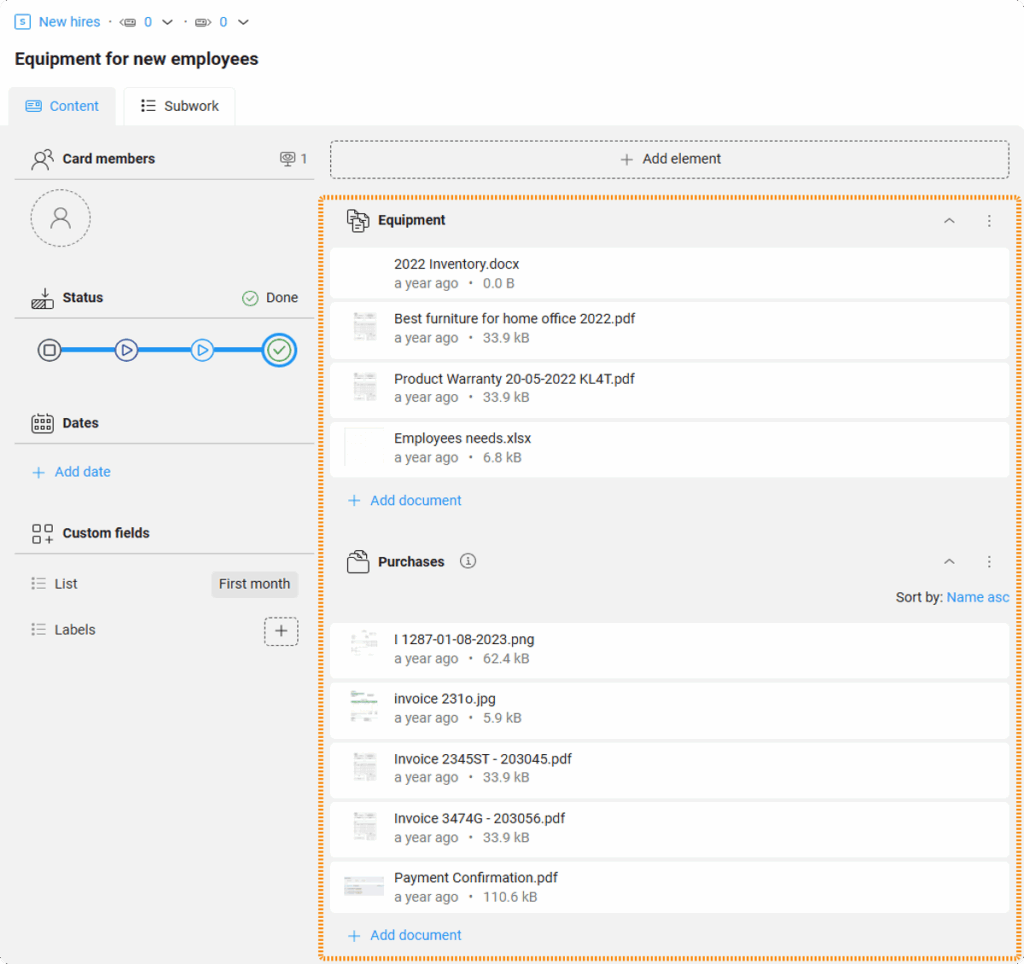
Card Documents
Documents are an integral part of work. Therefore, you can take them with you into the KanBo world. Add documents to cards and share them with other users. Edit existing files or create new ones.
Knowledge is captured as work evolves
Knowledge in KanBo is not written afterward. It emerges naturally as work progresses. This turns everyday execution into organizational memory — without extra effort.
Cards capture knowledge through:
| How cards capture knowledge | Role |
| Descriptions | that define scope and intent, |
| Notes | that explain decisions or reasoning, |
| Checklists | that encode procedures and best practices, |
| Discussions and mentions | that clarify why something was done. |
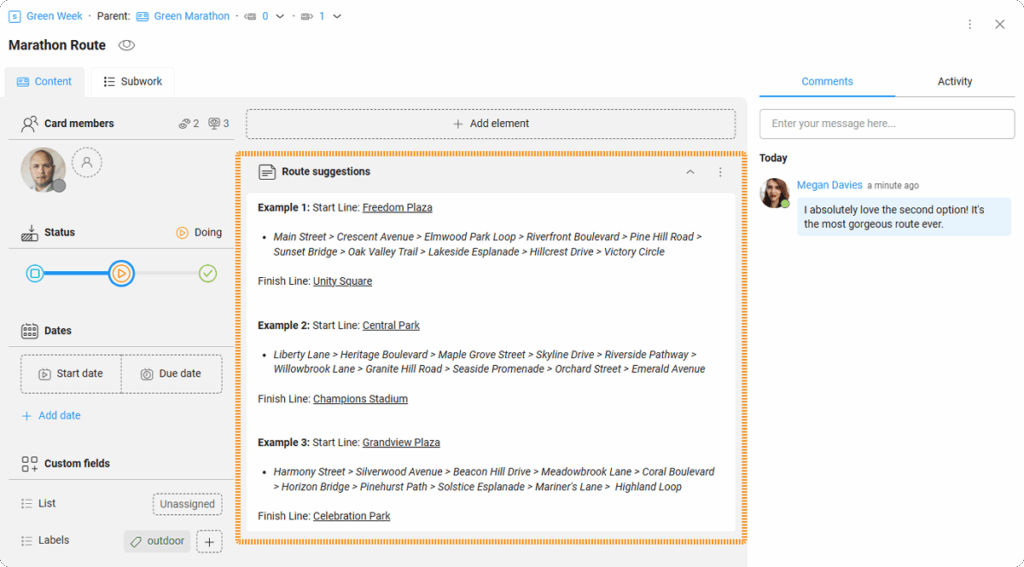
Notes
Notes are one of the card elements. It is a simple feature that allows users to store information and provide context for the card’s content.
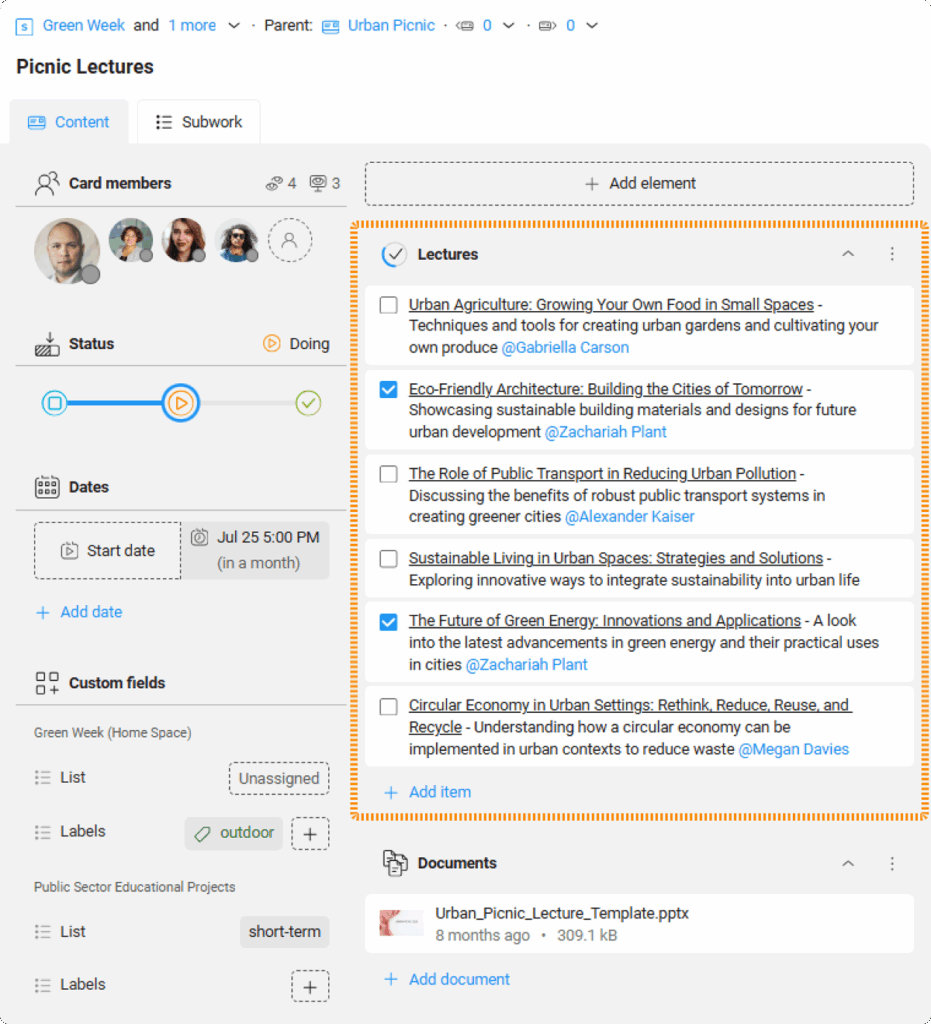
Checklists
Checklists are one of the card elements. It includes a list of tasks or items, along with checkboxes that allow you to mark off tasks as they are completed. It is a way to keep track of smaller items within a card.
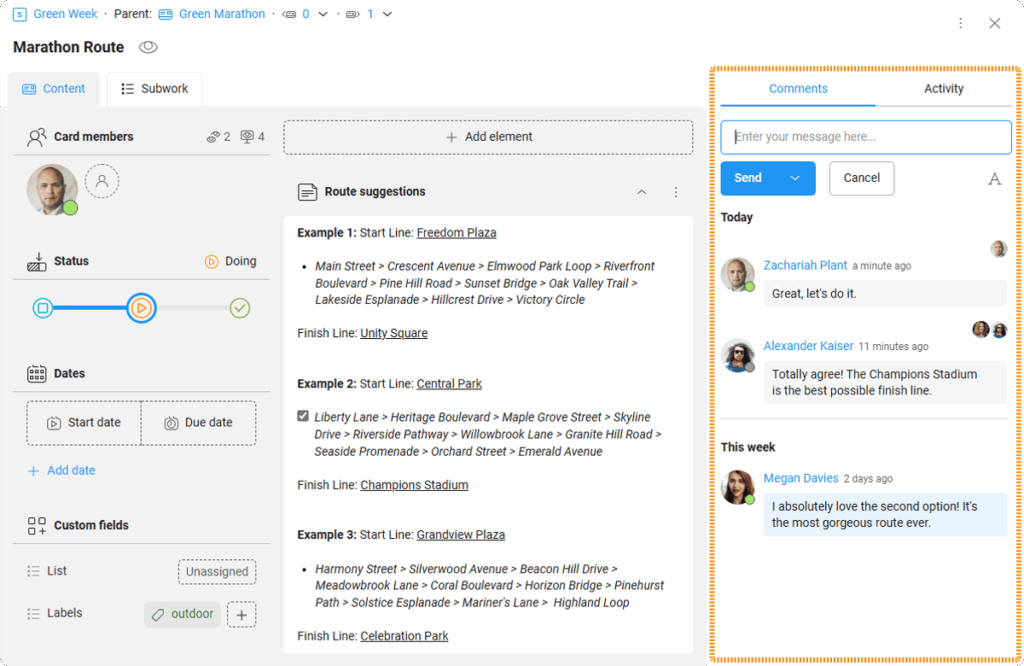
Messages
Messages in cards are a great way to collaborate with other KanBo users. They’re perfect for short conversations about card content. Use them to let your colleagues know about the latest news or ask for help.
Visibility follows permissions
Just like collaboration, document and knowledge access in KanBo is governed by roles:
- workspace and space roles (owner, member, visitor) define who can see documents,
- card roles define who works with them directly,
- observers can read and understand outcomes without modifying content.
This ensures that:
- sensitive information stays protected,
- knowledge is shared intentionally,
- and compliance requirements are met.
People see what they are allowed to see — and nothing more.
Documents remain traceable and auditable
Because documents are connected to cards and activity streams:
- every document addition or removal is visible,
- discussions around documents are preserved,
- decisions can be traced back to the exact version used.
This is critical for regulated environments, audits, and long-term accountability.
Documents are no longer detached artifacts. They become part of the execution trail.
The real risk is not disconnected knowledge — it is lost knowledge
In most organizations, knowledge is fragile. This loss is usually invisible — until the organization pays for it again.
KanBo is designed to preserve knowledge by design, not by discipline.
| Knowledge | Actions |
| Knowledge is lost when: | decisions are made in meetings and never written down, explanations live in emails or chats and cannot be found later, employees change roles or leave the organization, projects end and their context disappears, work is repeated because past reasoning is forgotten. |
| Knowledge is preserved through: | card descriptions that define intent and scope, notes that explain decisions and reasoning, discussions tied to concrete work, documents linked to the exact tasks and outcomes they support, activity streams that record how and why work evolved. |
In KanBo, knowledge is not something added afterward.
It is created as a natural by-product of work execution.
If work happens in KanBo, its knowledge is already captured.
Preserving Knowledge Through Work
When knowledge lives in individuals, it leaves with them. Cards, spaces, and workflows become institutional memory — not personal memory.
| Knowledge | KanBo | Benefits |
| Knowledge survives people, roles, and time: | When knowledge lives in KanBo: it remains after people change roles, it stays accessible when teams reorganize, it can be reused when similar work appears again. | This is critical for: long-running programs, regulated environments, and organizations with natural employee turnover. |
| Knowledge stays connected to outcomes: | In KanBo, knowledge is always connected to: the work it explains, the decisions it supports, and the outcome it helped produce. | This allows anyone reading a card to understand: what was done, why it was done, and under what conditions. |
Knowledge is no longer abstract. It is anchored to real execution.
Knowledge moves with work instead of being copied
When work changes context, knowledge often gets lost.
In KanBo:
- when a card moves between workflows or spaces,
- when responsibility changes,
- when work evolves from project to operations, its knowledge moves with it.
There is no need to rewrite, forward, or re-explain. Understanding is carried forward automatically.
Why this matters
KanBo does not try to “manage knowledge” as a separate discipline.
It prevents knowledge loss by embedding it directly into work.
| Knowledge | Outcome |
| Lost knowledge leads to: | repeated mistakes, unnecessary meetings, slow onboarding, and decisions made without historical awareness. |
| Preserved knowledge leads to: | faster execution, safer compliance, and continuous organizational learning. |
Key principle
If work happens in KanBo, its knowledge does not disappear.
This is one of the most powerful — and often underestimated — advantages of working in a connected execution system.
Natural transition
With work, communication, documents, and knowledge preserved, the next step is using this foundation to solve problems early and effectively.